
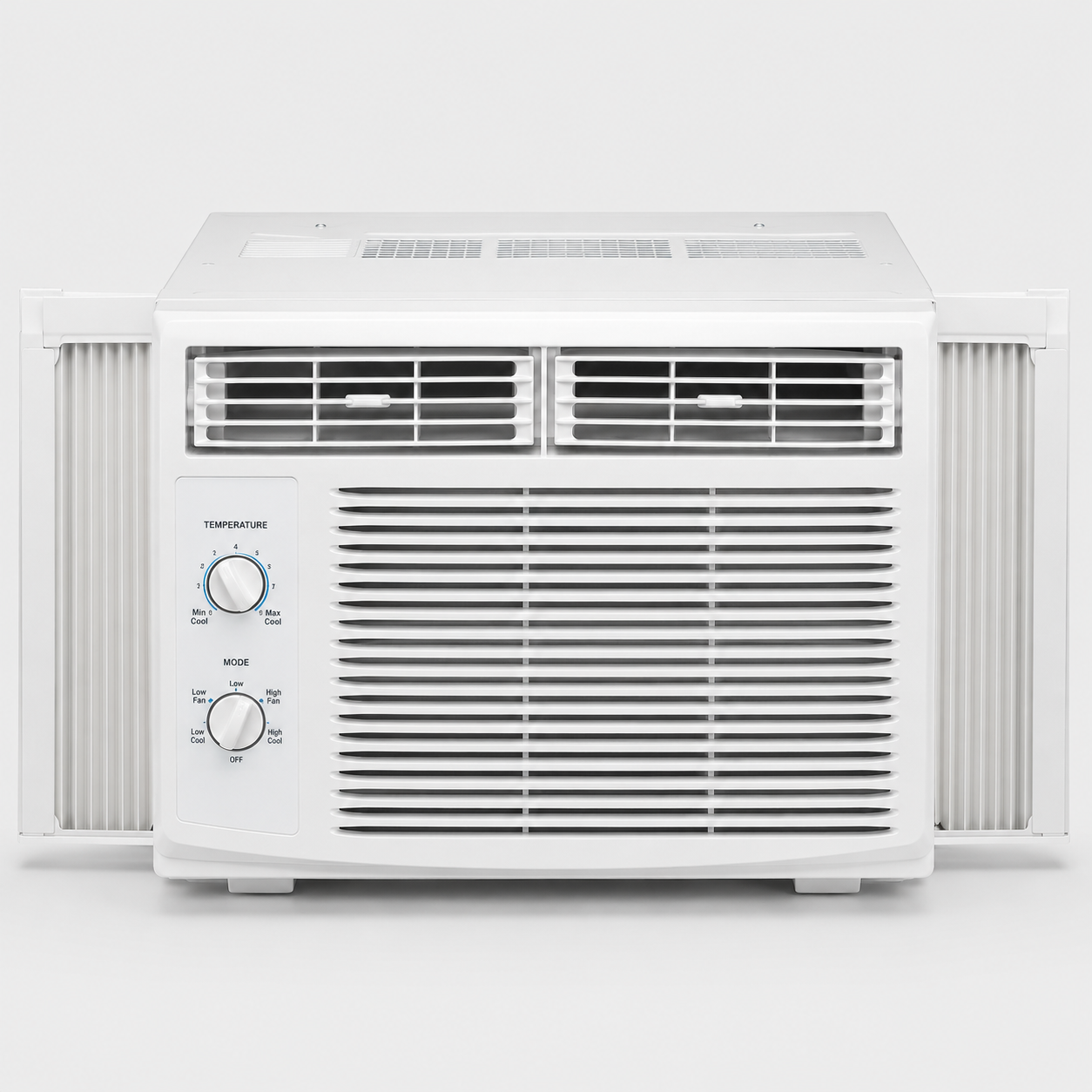
When the first real heat wave hits, window AC units come out of the closet and go straight into the window, usually with no thought about what it asks of your wiring.
At Castle Electric, our licensed Norwood and Newton electricians spend every summer answering the same call: a breaker that keeps tripping, an outlet that smells a little too warm, a unit that quits every time someone runs the microwave. In almost every one of those calls, the AC is fine and the wiring behind it is the real problem.
Here are the five mistakes we see most often, and what to do instead.
Mistake #1: Running the Unit on an Extension Cord
This is the big one. A window AC can pull anywhere from 5 to 15 amps, plus an extra jolt every time the compressor kicks on. Most household extension cords are built for lamps and phone chargers, not that kind of sustained, heavy load. Push too much current through an undersized cord and it overheats, which is how you get melted plugs, scorched receptacles, and in the worst cases, a fire.
The Consumer Product Safety Commission is blunt about it: plug window units straight into the wall. When the nearest outlet is a few feet out of reach, the answer isn’t a longer cord. It’s a properly placed outlet installed right where you need it. If you’re truly stuck for a day or two, use a heavy-duty, air-conditioner-rated cord (12-gauge, grounded) as a short-term stopgap only.
Mistake #2: Sharing a Circuit With Everything Else
Here’s a pattern we see constantly. The AC runs fine on its own, but the second you plug in a box fan, charge a phone, or flip on a lamp in the next room, the breaker trips. That’s no coincidence. Window units are heavy, continuous draws, and sharing a circuit with a few other outlets is often all it takes to push the whole thing past its limit.
If your breaker only trips when the AC is running, that’s your telltale sign. The fix usually isn’t resetting the breaker again, and it isn’t a bad breaker either. It’s a dedicated circuit that gives the unit its own line straight from the panel, so it isn’t fighting the lamp and the TV for the same handful of amps.
Mistake #3: Treating Repeated Trips as Normal
Flipping the breaker back on is tempting, and a single trip during a brutal heat wave isn’t necessarily cause for alarm. A breaker that trips again and again all season, though, is trying to tell you something.
Repeated trips can point to an overloaded circuit, a breaker that’s wearing out, or a wiring problem that quietly gets worse the longer it sits. Guessing is the expensive part. Castle Electric’s $95 diagnostic service call puts a licensed electrician on the actual cause, and that fee gets credited toward the repair if the final invoice comes to more than $500. When your breaker keeps tripping, it’s worth finding out why.
Mistake #4: Plugging Into the Wrong Kind of Outlet
Plenty of older Newton and Norwood homes still have outlets installed long before central air or modern appliances were a concern. Some are still two-prong and ungrounded. Others sit right by windows, where they catch moisture every time it rains. Neither is a good match for a window unit.
Grounding is the piece people overlook. It’s the safety path that carries current away if something inside the unit shorts out, and a two-prong outlet doesn’t have one. Pulling the ground prong off your plug, or forcing on an adapter to make it fit, creates a real shock risk. If your home still runs on older ungrounded outlets, or you’re not sure the one by your window is up to the job, that’s worth a professional inspection before AC season.
Mistake #5: Ignoring an Aging Electrical Panel
Sometimes the window AC isn’t the real culprit; it’s just the extra load that finally exposes a panel that’s been overdue for attention. Homes built between the 1950s and 1980s around Newton often still run on original fuse boxes or dated panel brands, and summer cooling is often what tips a marginal panel into trouble.
One brand deserves a callout: Federal Pacific Electric, or FPE. Independent testing has found its Stab-Lok breakers fail to trip in roughly half of overload situations, and experts have linked them to thousands of house fires a year. Swapping out individual breakers doesn’t fix it, because the flaw is in the design. If your home has an aging or undersized panel, a summer breaker trip is a solid reason to have it evaluated, and if you find an FPE label behind that door, full replacement is the only real answer.
How to Tell It’s Time to Call an Electrician
A few signs are worth acting on instead of working around:
- A breaker that trips more than once or twice in a season
- An outlet or plug that feels warm, looks discolored, or gives off a faint burning smell
- Two-prong, ungrounded outlets anywhere you run window units
- A panel that’s original to an older home, or any panel labeled Federal Pacific
The warm outlet is the one to take seriously right away. That’s an emergency worth a same-day call, not something to sleep on.
Keep Your Cool the Right Way This Summer
Window units are a fine way to get through a Massachusetts summer, as long as they don’t cost you your wiring or your peace of mind. Castle Electric has kept homes safe and comfortable across Newton, Norwood, and 55-plus eastern Massachusetts communities since 1997, and our licensed electricians can track down a stubborn breaker, add the outlet or circuit you’re missing, or check whether your panel is ready for another season.
Book an appointment with Castle Electric and head into the hot months knowing your home can handle the load. Your house should be the one place a heat wave can’t rattle. Castle Electric is licensed under Massachusetts Master Electrician License A16191.