
If your Newton home was built before 1950, there’s a real chance the walls are holding a secret, and not a good one.
The Norwood and Newton electricians at Castle Electric have worked inside hundreds of older Eastern Massachusetts homes, and one of the most common things we find is knob and tube wiring that’s still active, decades past its useful life. Homeowners are often surprised. The lights work, the outlets work, so how bad can it really be?
Pretty bad, actually. Here’s what you need to know.
What Is Knob and Tube Wiring?
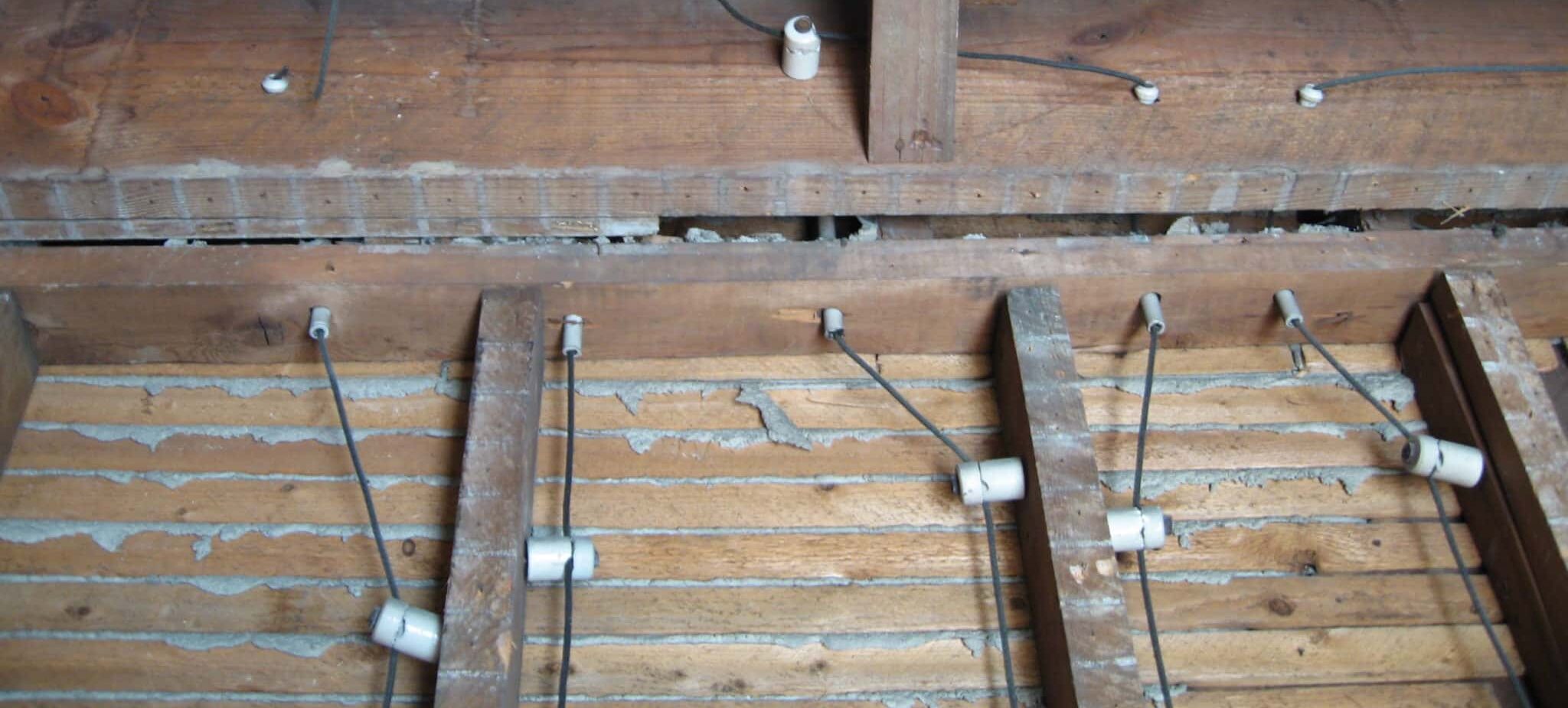
Knob and tube (K&T) was the standard wiring method for American homes from roughly the 1880s through the 1940s. Individual copper wires ran through walls and ceilings, supported by ceramic knobs and protected through framing by ceramic tubes. For its era, it was a legitimate system. By today’s standards, it’s a liability.
The two biggest structural problems: it has no ground wire, and it was never designed to carry the electrical loads a modern home demands. Your refrigerator, microwave, window AC units, and EV charger are pulling far more current than a 1920s electrical system was ever built to handle.
Why Age Makes It Worse
The insulation wrapping K&T wire is rubber and cloth. After 80 to 100 years, that material dries out, becomes brittle, and cracks, leaving bare copper exposed inside your walls where you can’t see it. Arcing across those exposed conductors can reach temperatures high enough to ignite wood framing.
There’s another problem specific to older New England homes: blown-in attic insulation. Knob and tube was engineered to dissipate heat in open air. The moment you cover active K&T runs with insulation, something most Newton and Norwood homeowners have done for energy efficiency, you’ve eliminated the system’s only cooling mechanism. That’s a leading cause of K&T fires.
Add in decades of unknown DIY splicing and modifications by previous owners, and you have a wiring system that’s genuinely unpredictable.
The Insurance Problem
Many homeowners discover their K&T situation not from an electrician, but from their insurance company. A growing number of Massachusetts insurers will not cover homes with active knob and tube wiring, or they’ll charge premiums 50 to 100 percent higher. Some policies are cancelled outright when K&T is discovered during a home inspection. If you’re buying or selling a home in Newton, this is a real transaction risk.
How to Tell If You Have It
The clearest signs:
- Your home was built before 1950
- You have two-prong outlets throughout the house (no ground)
- You can see ceramic knobs or tubes in an unfinished basement or attic
- Your breakers trip frequently under normal use
- You notice flickering lights or warm outlet covers
The only way to know for certain is a professional electrical inspection. K&T isn’t always visible without opening walls, and a licensed electrician knows exactly where to look and what to look for.
What Happens During a Knob and Tube Removal
A full knob and tube removal involves running modern copper wiring through your home’s existing framing, replacing the old system circuit by circuit. It’s a significant project, but it doesn’t have to happen all at once. Many Newton homeowners start with a mapping inspection (Castle Electric offers these for around $300) that documents exactly where active K&T runs exist, then prioritizes the highest-risk areas first.
The result is a grounded system built for modern loads, fully up to Massachusetts electrical code, and insurable without penalty.
What About the Panel?
If your home has original knob and tube wiring, there’s a good chance your electrical panel is undersized too. Most pre-1960 homes were built with 60-amp service, enough for a much simpler time. A panel upgrade is often part of the same project, and it’s what makes the rest of your home’s electrical system actually safe: modern breakers, proper amperage, and room to grow.
While you’re at it, your electrician should also assess your switches and outlets. Ungrounded two-prong outlets are a direct symptom of a K&T system and need to be replaced as part of any rewire.
Don’t Wait for a Warning Sign
The nature of knob and tube failures is that they often happen invisibly, inside walls, before any visible symptom appears. By the time a light flickers or an outlet feels warm, something has already gone wrong.
If your Newton or Norwood home is older than 75 years, the most protective thing you can do is get eyes on your wiring. Contact Castle Electric to schedule an inspection and we’ll tell you exactly what’s in your walls, what’s active, and what needs to happen next.