
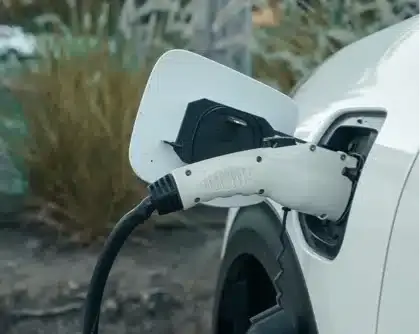
If you’re trying to add an EV charger without a panel upgrade in Newton, MA, you may have more options than you’ve been told. Plenty of homeowners call Castle Electric braced to hear the panel has to go. Sometimes it does. But many older homes in Newton and Norwood run on 100-amp service, and when the only problem is room for one big new load, a load management device can often make that room without replacing anything.
Two devices handle this well: the Tesla Remote Meter and the PSP Products SAK-60MS Load Shed Device.
What Load Management Does, in Plain English
Every breaker in your panel draws from the same pool of capacity. Run the dryer, oven and a Level 2 charger at once, and an older panel hits its limit fast.
A load management device acts as a gatekeeper. It watches your panel’s total draw in real time, holds the charger back when the house gets busy and releases it when things quiet down. The two devices differ in how they hold it back.
How the Tesla Remote Meter Works
The Tesla Remote Meter is a small energy meter installed inside your panel. It pairs with Tesla’s Gen 3 Wall Connector or Universal Wall Connector to run a feature Tesla calls Dynamic Power Management.
Instead of shutting the charger off, Dynamic Power Management turns the charging speed down. Start the dryer and oven while the car’s plugged in, and the meter lowers the charger’s amperage to keep the panel under its limit, then ramps back up once the dryer finishes. The car keeps charging the whole time, just slower. During setup, the installer caps the system at 80% of your panel’s rating for a safety margin.
A few details to know before choosing this route:
- Tesla only approves the meter for load management with the Gen 3 and Universal Wall Connectors.
- The Universal Wall Connector also charges non-Tesla EVs.
- The meter costs about $210, plus the charger and installation.
For most households, steady charging and a low equipment cost make this the easier choice.
How the PSP Load Shed Device Works
PSP Products’ SAK-60MS lets an electrician add a new load of up to 60 amps to a main panel or sub-panel that’s at or near capacity.
Its controller only powers the new load when there’s room, and it acts like an on/off switch. When the panel nears its limit, the charger loses power completely until capacity frees up, then switches back on.
The PSP device has real strengths for homes with equipment already in place:
- It works with any charger brand.
- It can manage non-EV loads up to 60 amps.
- Your electrician can adjust its thresholds and delays, and an LCD screen shows live panel amperage.
- It’s UL Listed.
The equipment retails for about $798, plus installation.
How the Two Devices Compare
Side by side, the two devices split on four points:
- How they manage load: Tesla turns charging speed down and back up. PSP cuts power completely, then restores it.
- Compatibility: Tesla works only with the Gen 3 or Universal Wall Connector. PSP works with any charger brand, or any load up to 60 amps.
- Equipment cost: About $210 for the Tesla meter, plus the charger. About $798 for the PSP device.
- Best fit: Tesla suits most EV owners, especially anyone buying a new charger. PSP suits homeowners keeping a non-Tesla charger or managing a non-EV load.
For most homes, that comparison tips toward Tesla.
Which One Fits Your Home
For most EV owners in Newton and Norwood, we’d point you toward the Tesla Remote Meter. The car keeps charging through busy evenings, and it costs less up front.
The PSP device makes more sense if you already have a ChargePoint, Emporia or other non-Tesla charger you’d rather keep, or if the load you’re adding is another large appliance.
When a Panel Upgrade Is Still the Better Call
Load management works best when you’re adding one big load to a panel that’s otherwise in good shape. We’d usually recommend a panel replacement or upgrade instead when:
- You’re adding several large loads at once, like an EV charger, a heat pump and an induction range.
- Your panel is outdated, damaged or showing signs of failure.
- Circuit breakers already trip regularly under normal use.
- There are bigger electrical safety issues in the house to address first.
We’ll tell you plainly which situation you’re in.
Why You Need a Licensed Electrician
Both devices install inside your panel, next to the wiring that feeds your whole house. That’s licensed-electrician territory.
Choosing the right device starts with a load calculation: your panel’s rating, what’s already on it and how your household uses power. When we assess an electrical panel, that calculation shows whether load management will hold up.
Find Out What Your Panel Can Handle
Whether you’re in Newton, Norwood or a town nearby, we’ll look at your panel, run the load calculation and give you a straight answer on whether load management or an upgrade fits your home. Read more about our EV charger installation work, or book a panel assessment and we’ll take it from there.